
Your First Swim Meet!
Swim Meets – Everything you always wanted to know about swim meets but were afraid to ask (or didn’t know to ask)
While this is by no means the all-inclusive guide to swimming, it will most definitely help you to understand some of the basics that your fellow seasoned parents sitting next to you in the stands may already know. We have tried to compile as much information as possible within the guide to help answer any of your questions that may come up randomly during the day. However, you will undoubtedly have a question that can’t be answered with this. Usually, it will happen at a time when the person you need to ask isn’t around, at least that’s the way it always happens. Please do not wait to ask a question. Even the smallest topic may be very important to your better understanding of what swimming is about. While many seasoned parents can be a good source of information about swimming, most of the technical questions should be posed to a coach to answer. Either way, please feel free to ask when a question pops up that you are not sure of. Hopefully, whomever you ask will have an accurate answer for you. If in your first few seasons as a new parent, there is information you feel isn’t in here that should be, please let us know and we’ll be sure to add it for future families to improve their understanding of our little “world”.
The Four Strokes
The four competitive swimming strokes are freestyle, backstroke, breaststroke and butterfly. The combination of all four strokes is called individual medley.
In freestyle events, the competitor may swim any stroke. The stroke most commonly used is sometimes called the crawl, which is characterized by the alternate stroking of the arms over the surface of the water surface and an alternating (up-and-down) flutter kick.
Backstroke consists of an alternating motion of the arms with a flutter kick while on the back. On turns, swimmers may rotate to the stomach and perform a flip turn and some part of the swimmer must touch the wall. The swimmer must finish on the back.
The breaststroke requires simultaneous movements of the arms on the same horizontal plane. The hands are pressed out from in front of the breast in a heart shaped pattern and recovered under or on the surface of the water. The kick is a simultaneous somewhat circular motion similar to the action of a frog. On turns and at the finish, the swimmer must touch the wall with both hands simultaneously at, above or below the water surface.
Some consider the butterfly to be the most beautiful of the strokes. It features a simultaneous recovery of the arms over the water combined with an undulating dolphin kick. In the kick, the swimmer must keep both legs together and may not flutter, scissors or use the breaststroke kick. Both hands must touch the wall simultaneously on the turns and the finish.
The individual medley, commonly referred to as the I.M., features all four strokes. In the IM, the swimmer begins with the butterfly, then changes after one-fourth of the race to backstroke, then breaststroke and finally freestyle.
Competition 101
Rules
The technical rules of swimming are designed to provide fair and equitable conditions of competition and to promote uniformity in the sport. Each swimming stroke has specific rules designed to ensure that no swimmer gets an unfair competitive advantage over
another swimmer.
Course
Competition pools may be short course (25 yards or 25 meters), or long course (50 meters). The international standard (as used in the Olympics) is 50 meters. World records are accomplished in 25 and 50 meter pools. USA Swimming maintains records for 25 yard, 25 meter and 50 meter pools.
Competition
Participants compete in different age groups and meets depending on their achievement level and how old they are on the first day of the meet. Traditionally recognized age groups are 8 and under, 9-10, 11-12, 13-14, 15 and over. Many local meets feature 8 and under, single age groups, or senior events.
Officials
Officials are present at all competitions to enforce the technical rules of swimming so the competition is fair and equitable. Officials attend clinics, pass a written test and work meets before being certified. All parents are encouraged to get involved with some form of
officiating.
Swim Meet Basics
Swim meets are a great family experience. They're a place where the whole family can spend time together. Listed below are some very in-depth guidelines geared to help you through your first couple of swim meets. It may seem a little overwhelming, but we tried to be as specific and as detailed as we possibly could. If you have any questions, please ask your coach or your group moms.
Before the Meet Starts
Arrive at the pool at least 15-20 minutes before the scheduled warm-up time begins. This time will be listed in the information email sent prior to the start of the meet. Consider how much time it will take you to travel to the meet and how much time will be required for you to get your swimmer and all necessary gear from the car, through the parking lot, and into the rest area. (Sometimes backpacks or a wagon help!)
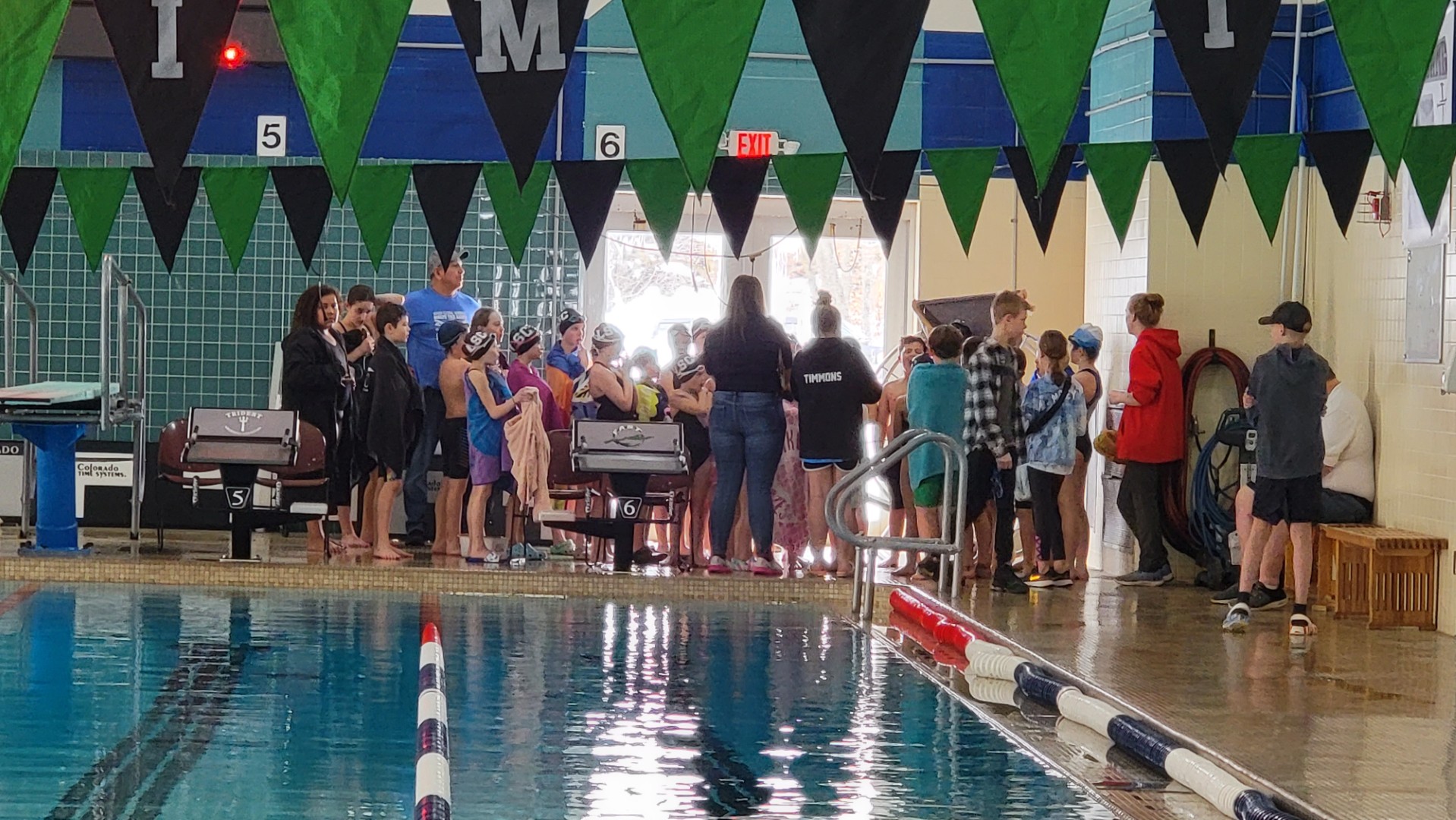
Upon arrival, find a place to put your swimmer's blankets, swim bags and/or sleeping bags. The team usually sits in one place together, so look for some familiar faces.
Find the heat sheets! Some meets charge admission or require payment to purchase a heat sheet. (Heat Sheets list all the events, heats, lanes, and swimmer’s names.) At other meets admission is free or heat sheets can be found online and printed.
Using the heat sheet, write each event-heat-lane number-stroke on your swimmer's hand/arm in ink (How to Mark Your Swimmer's Arm). This helps your swimmer remember what events he/she is swimming and what event number to listen for in staging. It also helps coaches, teammates, and staging volunteers help your swimmer get to the right place if they need assistance.
Your swimmer now gets his/her cap and goggles and reports to their coach for warm-up instructions. It is very important for all swimmers to warm-up with the team. Swimmers’ bodies are just like cars on a cold day. Swimmers need to get the engine going and warmed up before they can go all out.
Depending on how large the facility is and how many swimmers there are at the meet there may be multiple warm up sessions. After warm-ups, your swimmer will go back to the area where his/her towels are and sit there until their event is called. Your swimmer will need to determine if the meet is about to start directly after our warm-ups, or if he/she has enough time to go to the bathroom, get a drink, or just get settled in and ready.
KEEP YOUR SWIMMERS WARM! PARKAS, SWEATSUITS, KNIT HAT, SHOES. These are all essential to keeping the body warm. Swimmers should wear right up until they are behind the blocks.
According to USA Swimming rules (because of insurance purposes), parents are not allowed on deck unless they are serving in an official capacity. Similarly, all questions concerning meet results, an officiating call, or the conduct of a meet, should be referred to the coaching staff. They, in turn, will pursue the matter through the proper channels.
Heat Sheets
A paper copy of the heat sheet is usually available prior to the meet start. Some meets also have heatsheets available online. Heat Sheets list all swimmers in each event in order of "seed time", or the time each swimmer has for an event coming into the meet. When the team entry is sent in, each swimmer and his/her previous best time in that event is listed. If the swimmer is swimming an event for the first time, he/she will be entered as a "no-time" or "NT". A "no-time" swimmer will most likely swim in one of the first heats of the event.
Food and Drink for Your Swimmer
It is important to keep hydrated and fueled between events, but that also does not mean sugared up. Eat a good dinner the day before, a good breakfast the day of, some healthy snacks and WATER. Usually only water is allowed on deck and snacks should be consumed in the lobby areas.
Meet Start
Parents are encouraged to hang out in the rest area or in the stands during a meet. Swimmers are only allowed on the deck, but can can find parens to communicate and get a hug for a job well done.
It is important for any swimmer to know what event numbers he/she is swimming (again, why they should have the numbers on their arm). He/she may swim right away after warm-up or they may have to wait awhile.
Swim meets can sometimes best be described as organized chaos everywhere except for the swimmers in the pool. There are hundreds of swimmers, one heat after another, with very few breaks in between. The volunteers/coaches/ older teammates will do everything possible to help your swimmer be behind the blocks at the proper time, but they also need to be aware of what is going on.
Swimmers 10 and under are required to stage to ensure they make it to the correct spot for their race. At the venue, look for the staging area and help your swimmer find their way there when it is time to stage for their upcoming race. Swimmers 11 and older must "stage" themselves and are responsible to find their way to the starting blocks. For USA Swimming and State Meets, your swimmer should find where the team is sitting on deck. The team sits in one place together, so look for some familiar faces. Here your swimmer can place their blankets/towels, swim bags, etc.
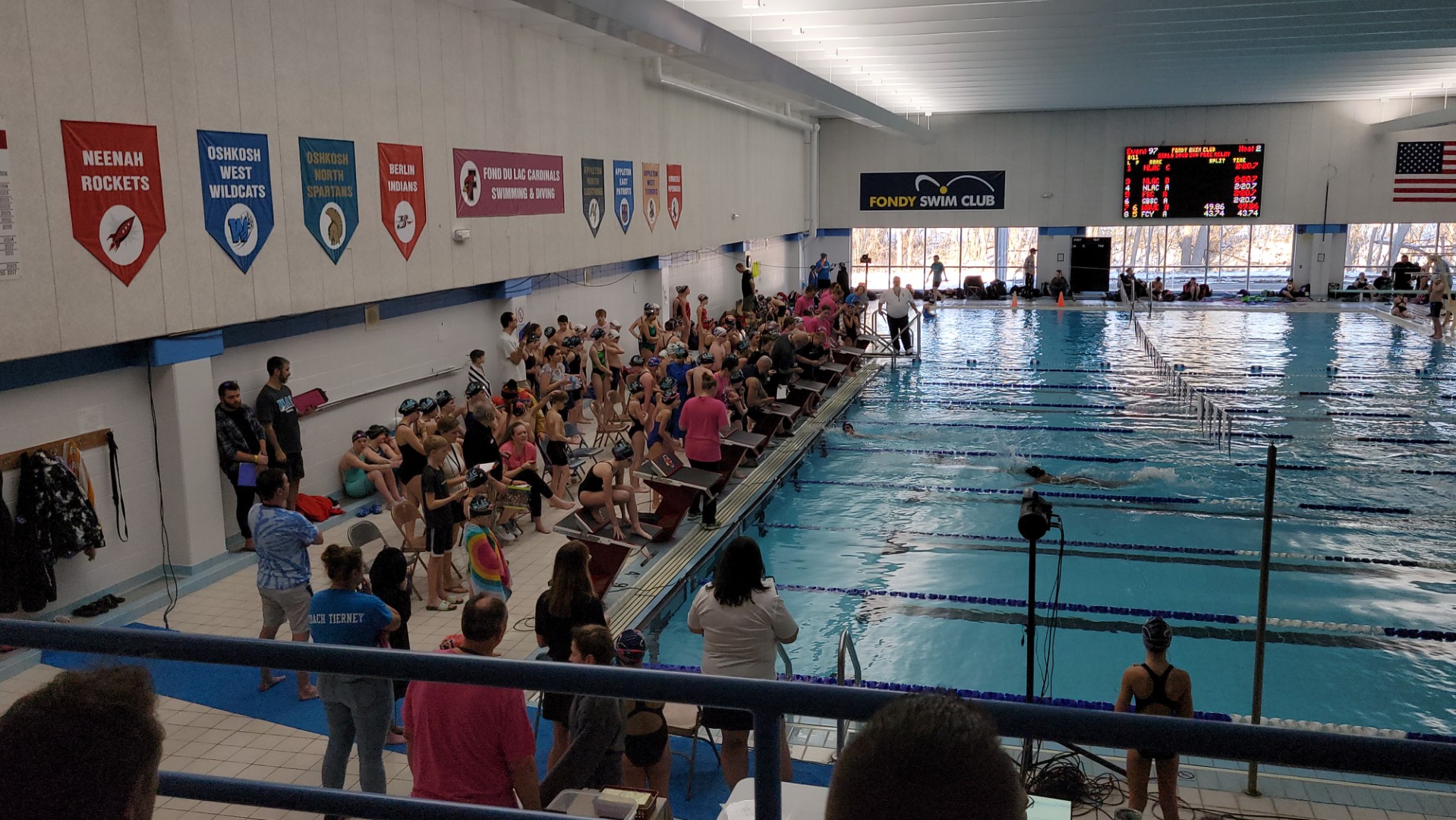
The event number and heat number for the current event will be on the scoreboard. Staging volunteers will help your swimmer go up the event BEFORE their event so they are ready and behind the blocks and in the proper lane. Swimmers should report with his/her cap on and goggles ready.
The swimmer swims their race. All swimmers should talk to a coach after their race for feedback. REMEMBER FEEDBACK ON PERFORMANCE COMES FROM THE COACHES NOT THE PARENTS!!!
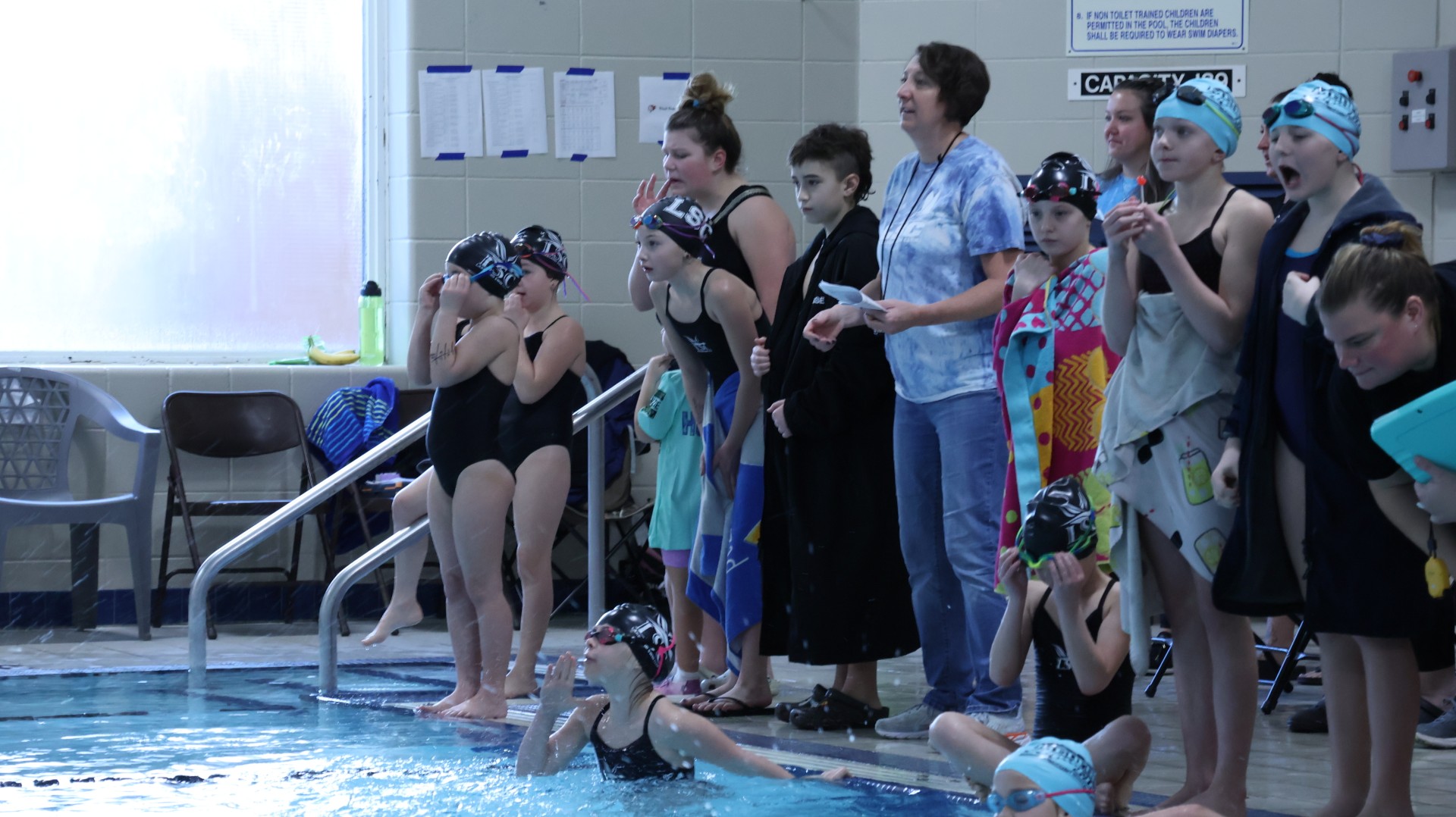
Once the race is complete, swimmers are encouraged to do whatever they need to prepare for their next event: rest in the rest area, hang out with teammates on the pool deck, cheer on your teammates in the stands.
End of Meet
After your swimmer has swam all his/her events, we encourage you to stay and help cheer on their teammates. If you must leave, be sure your swimmer checks with their coach before leaving to make sure there aren’t any other events (i.e. relays) for which your swimmer is scheduled.
Results are usually posted somewhere in the facility and available on the Meet Mobile app. Awards are often gathered for a team and given to the coach at the end of the meet. The coach will give the awards to the swimmers at a later time.
What Happens If Your Child has a Disappointing Swim
If your child has a poor race and comes out of it feeling bad, talk about the good things. Be encouraging and supportive. If your child comes up to you and says, "That was a bad race, don't tell me it wasn't," there is nothing wrong with a swimmer negatively evaluating a race. The important thing is for the child not to dwell on it. You should move the swimmer on to something good. "All right, you have had a bad race. How do you think you can do better next time?" Immediately start talking about the positive things. Encourage them to talk with their coach.
What Happens If Your Child is Disqualified (DQ) During Their Race
Each meet has officials who observe the swimmers during the races. Officials are making sure each swimmer is using the proper technique for the type of race that is being swam. If the official sees an infraction, they will fill out a DQ slip that is passed on to the coach. The coach uses the DQ to talk to your child about the problem they had with their stroke. Officials are not purposely looking to DQ your child but are ensuring that all swimmers are following the same rules for each race. DQ’s happen more frequently in the younger age groups. A DQ does not mean your child has failed but is providing feedback for your child to learn to become a better swimmer. Again, swimmers should discuss these with their coach.
Questions
If you do not understand why or how something is just ask. There will be plenty of experienced swim parents around to help you.
Special Note
The pool area is usually very warm. Therefore, you need to make sure you dress appropriately. Nothing is worse than being hot at a swim meet. It makes the time pass very slowly!